


-

Blob Opera
-

The Choicest Voice
-

SpongeBob Is This How You Get Your Sick Kicks
-

Hiding from Randall Monsters Inc
-

Dance Moms – GET YOUR FINGER OUT OF MY FACE
-

Doppio switch into Diavolo
-

SpongeBob SquarePants – Insultin a mans ship
-

Ichigo vs Grimmjow
-

Family Guy Peter Does Crack
-
TAWOG Have You Noticed That Your Voice Has Changed – The Castle
-

Kung Fu Panda o sigma da Bahia
-

Peter Griffin Plays Call of Duty Dub
-
Stutter incident – Joe Bart
-

No This Is My Lolly

Family Secrets 1: Empty Plate













![SEU MANIACO [PT-BR]](https://thechoicervoicergames.com/wp-content/uploads/2026/09/Seu-Maniaco_12_11zon-200x150.webp)








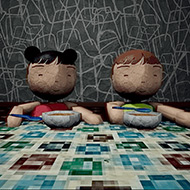
In Family Secrets 1: Empty Plate you start with a phone call that sounds ordinary enough, Mom leaving for work for several days, leaving Miko in charge of his younger sibling Jun, and every scene afterward slowly curdles that mundane setup into something far more unsettling.
Miko and Jun: Childhood Responsibility at the Center of Family Secrets 1: Empty Plate
Rather than opening with an obvious threat, the game roots its horror in something far more grounded: a child suddenly responsible for another child, in a home that starts feeling wrong in ways too subtle to name at first. That framing gives the slow-burn tension real emotional stakes, since the fear isn’t just about what might be lurking in the house, but about Miko’s own fragile sense of control slipping as the days without his mother stretch on.
Players expecting a jump-scare-driven horror experience often miss the quieter details early on, dismissing an unfinished meal or a door left ajar as set dressing rather than a genuine clue about Jun’s wellbeing. Players who slow down and actually inspect the house instead start piecing together the household’s unraveling well before the story spells it out directly.
By the time Jun’s behavior shifts noticeably from the opening scenes, the earlier details a careful player noticed stop feeling incidental and start feeling like the actual warning they were.
Exploration and Light Puzzles Inside Family Secrets 1: Empty Plate
Mechanically, the game keeps things simple: a first-person walking simulator where Miko explores the house, interacts with objects, and pieces together the unraveling situation through light puzzle-solving rather than combat or complex systems.
- Object interaction: examining household items that hint at what’s actually happening to Jun
- Environmental storytelling: an unfinished meal, a door left ajar, details that reward close attention
- Light puzzles: simple obstacles tied to caring for Jun rather than combat or reflex challenges
That restraint keeps the focus squarely on atmosphere and narrative discovery, letting small details around the home do the storytelling work instead of relying on mechanical complexity to generate unease, a design choice that answers a common question directly: no, there is no combat or chase sequence forcing tension artificially.
A Compact, Focused Runtime for Family Secrets 1: Empty Plate
The story wraps in roughly thirty to forty minutes, a runtime built for a single sitting that suits its slow-burn, single-location structure well. Stretching the premise further would risk diluting the tension between Miko and Jun’s situation, so the game keeps its focus narrow rather than padding the house with extra rooms or side content.
Players who rush through tend to miss the cumulative weight of small details, since no single object or line of dialogue is meant to carry the story alone. Players who linger in each room instead notice how the same detail, revisited later, reads completely differently once more of Jun’s situation has come into focus.
A fair point some players raise is that the short runtime leaves certain threads around the household underexplained, though that restraint is also what keeps the central tension between Miko’s responsibility and his own fear from getting diluted.
What makes Family Secrets 1: Empty Plate stand out among short horror releases is how firmly it grounds its dread in Miko and Jun’s relatable family situation before ever leaning on anything supernatural, and that emotional honesty, paired with a house worth exploring slowly, is exactly why the quiet unraveling between two siblings lands harder than a jump scare ever could.
Comments
There are no reviews yet. Be the first one to write one.