


-

Blob Opera
-

The Choicest Voice
-

SpongeBob Is This How You Get Your Sick Kicks
-

Hiding from Randall Monsters Inc
-

Dance Moms – GET YOUR FINGER OUT OF MY FACE
-

Doppio switch into Diavolo
-

SpongeBob SquarePants – Insultin a mans ship
-

Ichigo vs Grimmjow
-

Family Guy Peter Does Crack
-

TAWOG Have You Noticed That Your Voice Has Changed – The Castle
-

Kung Fu Panda o sigma da Bahia
-

Peter Griffin Plays Call of Duty Dub
-
Stutter incident – Joe Bart
-

No This Is My Lolly
Empty by Design: Why It Works
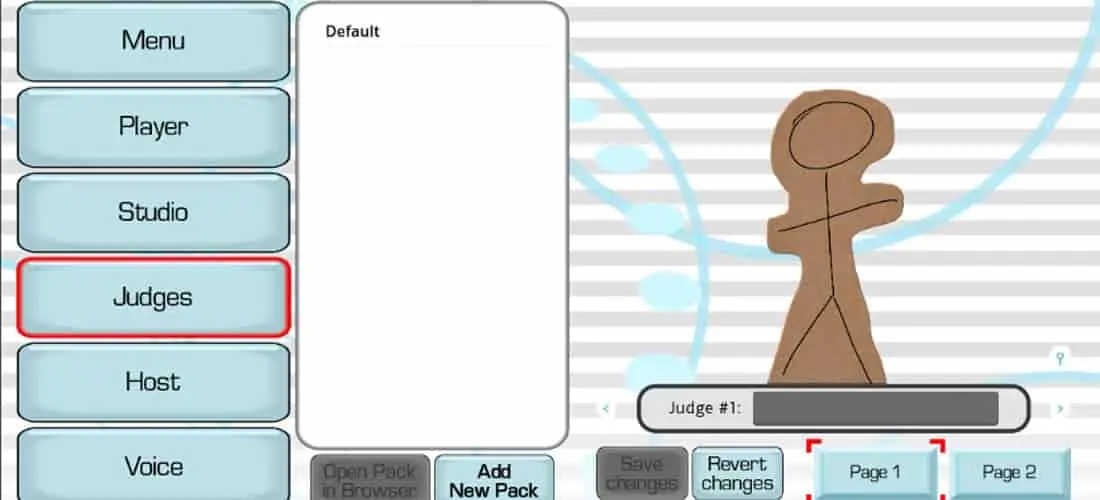
Most games try to impress you in the first five minutes. The Choicer Voicer does the opposite — it hands you a judge panel, a bare studio, and a folder with almost nothing in it, and lets you figure out what to do with that. On paper, that sounds like a game shipping unfinished. In practice, it’s one of the more deliberate design choices in the whole thing, and it’s worth understanding why an empty folder was the right call rather than a shortcut.
The Problem With Games That Come Fully Loaded
Most party games solve the content problem by licensing or building a fixed library up front — a set roster of characters, a set list of prompts, a set amount of material that eventually runs out. That approach has an obvious appeal: it works the moment you install it. But it comes with a quieter cost that shows up later. A fixed library has a ceiling. Play enough rounds and you start hearing the same lines, recognizing the same prompts, running out of reasons to load the game back up.
The Choicer Voicer sidesteps that ceiling entirely by never building one in the first place. There’s no licensed content to exhaust, because there’s barely any content shipped at all. The demo set exists purely to show you the folder structure — not to be the game itself. That’s a strange thing to hand a new player, but it’s also the thing that keeps the game from having an expiration date.
What “Empty by Default” Actually Buys You
Handing content control to players instead of licensing a fixed set does three things that a pre-loaded game structurally can’t:
| What You Get | Why a Licensed Library Can’t Match It |
|---|---|
| Content that never goes stale | A fixed set eventually gets fully memorized; a folder anyone can refill never does |
| Material relevant to your specific group | Licensed content has to appeal broadly; your own folder only has to appeal to the people in the room |
| A modding scene that’s part of the game, not a side project | A closed content library gives modders nothing to build toward; an empty one gives them the actual product |
That third point is easy to underrate. Because the game ships as a scoring engine rather than a finished content package, building and sharing packs isn’t an optional extra layer bolted onto the side — it’s most of what the community actually does. The Voice Packs ecosystem exists because the game needed it to exist, not because a small group of enthusiasts decided to make mods for fun on top of something already complete.
A fixed content library has a ceiling. An empty folder doesn’t — it just asks you to decide how high you want to build.
The Honest Trade-off: It Front-Loads the Effort
None of this is free. The cost of an empty-by-default design is that it moves work from the developer’s side to the player’s side, and the first session absorbs almost all of it. A player who boots up expecting a finished roster of characters is going to be disappointed for the first ten minutes, purely because the game asked them to bring their own content before it would let them actually play.
That’s a real design risk, and it’s not hidden — it shows up constantly in how new players describe their first session. The tradeoff only pays off if a player pushes through that initial setup, which is exactly why grabbing an existing community pack for your first run matters more here than in most games. The empty folder isn’t a wall meant to filter out casual players; it’s a cost that’s supposed to be paid once, not every session.
Why the Judge Panel Stays Neutral Because of This
There’s a less obvious benefit tucked inside this design that’s easy to miss: because the game never ships with its own fixed content, the scoring engine underneath was never built to favor any particular kind of material. A judge panel scoring pitch, timing, and clarity doesn’t need to know or care whether you’re performing a line from a beloved franchise, a private joke from your friend group, or something you recorded yourself an hour ago. The scoring stays generic on purpose, because the content was always meant to be unpredictable.
Compare that to a game built around a fixed roster — the scoring in that kind of game can quietly get tuned around the specific content it ships with, whether or not anyone intended that. The Choicer Voicer’s judge panel doesn’t have that luxury, and that constraint is what keeps it working just as well for a five-clip starter pack as it does for a two-hundred-clip themed compilation someone spent a month assembling.
Why This Keeps a Niche Game Alive Longer
Games built around a fixed, licensed content library have a natural lifespan tied to how much of that library exists. Once players have seen everything, the reasons to come back start running out, and the developer’s only lever is producing more licensed content — which is slow, and expensive, and eventually stops being worth it for a niche title.
An empty-folder design doesn’t have that problem, because the content pipeline was never the developer’s responsibility to maintain in the first place. The community keeps producing new packs independently of any release schedule, which means the game’s effective content library keeps growing long after a licensed-content title would have plateaued. That’s not an accident of a small, dedicated fanbase — it’s a direct consequence of a design that made the community the content pipeline from day one.
What This Design Costs the Developer
It’s worth being honest about the other side of this too. Handing content control to players means giving up control over first impressions, tone consistency, and quality across sessions — three things a licensed content library guarantees by default. A new player’s first pack might be excellent or might be a mismatched grab-bag, and that’s genuinely out of the developer’s hands. Reviews and first impressions of the game are shaped as much by which pack a player happened to install first as by anything the developer actually built.
That’s a real cost, not a footnote. A design built around an empty folder is betting that community-produced content will, on average, be good enough to carry the experience — and that bet only pays off if the community actually shows up to fill that folder. For The Choicer Voicer, it clearly has. But it’s a bet, not a guarantee, and it’s part of why a beginner’s first pack choice matters as much as it does.
The Bigger Picture
An empty folder is an unusual thing to hand a new player, and it’s fair to be skeptical of it on first contact. But it’s not an oversight or a placeholder for content that should have shipped — it’s the mechanism that keeps the game from ever running dry, keeps the scoring engine honest across wildly different content, and turns the community into the game’s actual content pipeline instead of an optional add-on. The cost is a rougher first session. The payoff is a game that, unlike almost anything with a fixed roster, doesn’t have a ceiling on how long it stays worth coming back to.