


-

Blob Opera
-

The Choicest Voice
-

SpongeBob Is This How You Get Your Sick Kicks
-

Hiding from Randall Monsters Inc
-

Dance Moms – GET YOUR FINGER OUT OF MY FACE
-

Doppio switch into Diavolo
-

SpongeBob SquarePants – Insultin a mans ship
-

Ichigo vs Grimmjow
-

Family Guy Peter Does Crack
-

TAWOG Have You Noticed That Your Voice Has Changed – The Castle
-

Kung Fu Panda o sigma da Bahia
-

Peter Griffin Plays Call of Duty Dub
-
Stutter incident – Joe Bart
-

No This Is My Lolly

Dirt Clicker













![SEU MANIACO [PT-BR]](https://thechoicervoicergames.com/wp-content/uploads/2026/09/Seu-Maniaco_12_11zon-200x150.webp)






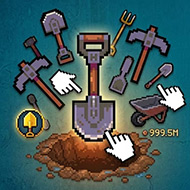
Dirt Clicker looks like a joke about digging with a spoon, but it plays like a resource-management game wearing a very silly costume. That gap between first impression and actual depth is most of what keeps players around past the opening minutes.
The Spoon, the Dirt, and the First Real Choice
Every run of Dirt Clicker begins the same way: a spoon, a patch of dirt, one dig at a time. It’s slow on purpose, and it stays slow just long enough that the first upgrade feels earned rather than automatic. Once that upgrade lands, the game’s real shape starts to show — a skill tree, a set of hirable workers, and layers stacked beneath the starting patch of ground.
The first meaningful decision isn’t really about tools, though. It’s about whether to spend early currency on the skill tree right away or save it for the first helper. Both paths work, but they lead to noticeably different early games — one leans on manual clicking a bit longer, the other gets automation online sooner at the cost of a slower skill tree.
Mushroom Buddies, Dirt Golems, and Druids
The three helper types in Dirt Clicker aren’t interchangeable, even though it can look that way at first glance. Mushroom Buddies fill the entry-level role — low upkeep, predictable output, nothing that punishes a player for hiring one too early. Dirt Golems trade that safety for raw output, hitting far harder per action once you can afford a few. Druids never touch the dirt themselves; their entire job is amplifying whichever workers happen to be positioned near them, which flips their value from nearly zero in isolation to significant once there’s a crowd around them.
A team of all Dirt Golems will out-dig a mixed team in short bursts. A mixed team with a Druid or two supporting a smaller number of Golems tends to hold up better over a longer stretch, once the numbers involved get large enough for the boost to compound.
What Changes Once You Pass the First Few Layers
Difficulty in Dirt Clicker doesn’t ramp evenly. The first layer is forgiving almost to a fault, designed to let new players get comfortable with the loop. Later layers ask for more — better tools, a more deliberate skill tree, and a worker setup that’s actually been tuned rather than assembled at random.
Relics and puzzle pieces scattered through each layer aren’t just collectibles. Several of them tie into unlocks that make the following layer meaningfully easier, which means a player who skips exploration to chase depth can end up worse off than one who took the slower route.
This is one of the more divisive aspects of the game among players — some want to be rewarded purely for depth and pace, and find the emphasis on full exploration slows the momentum they came for. Others see the layered loot as the actual point of the design. Dirt Clicker doesn’t fully resolve that tension; it just lets both playstyles function.
The Skill Tree’s Sharper Edges
Deeper into the skill tree, Dirt Clicker starts handing out spells rather than plain stat boosts. A handful sit far enough outside the normal curve that they let a player sidestep bottlenecks the rest of the tree is built around — the kind of thing that usually gets patched out of incremental games rather than left in on purpose.
Reaching those spells takes real investment first, though. Digging power, worker efficiency, and loot odds all sit earlier in the tree, and skipping toward the flashier spell nodes too early tends to leave a player under-equipped for the layers they’ll need to survive to actually use them.
Watching Your Own Setup Work
A built-in stat tracker shows which workers are contributing and which are effectively idle, which matters more than it sounds like once a run includes several Mushroom Buddies, a couple of Dirt Golems, and at least one Druid. It’s easy to assume more workers automatically means more output, and the tracker is usually what corrects that assumption.
What’s the fastest way to unlock new layers in Dirt Clicker?
Balancing skill tree investment with a mixed worker team tends to open layers faster than leaning entirely on manual clicking or entirely on automation alone.
Should I hire Druids before I have other workers to support?
No — a Druid hired too early has nothing to amplify and sits at close to zero value, so it’s worth building up a small team of other workers first and bringing a Druid in afterward.
Do relics actually affect progression in Dirt Clicker, or are they just collectibles?
Some relics feed directly into unlocks that make later layers easier, so treating every relic as purely cosmetic can leave real progress on the table.
The joke about the spoon only lasts as long as the first layer does — after that, Dirt Clicker is really about reading a skill tree correctly, knowing when a Mushroom Buddy has stopped pulling its weight, and deciding whether the puzzle piece sitting in the corner of the map is worth the detour it costs.
Comments
There are no reviews yet. Be the first one to write one.